
Cliffords Tower
Entry fee £2.50 per adult
Report by Midgey
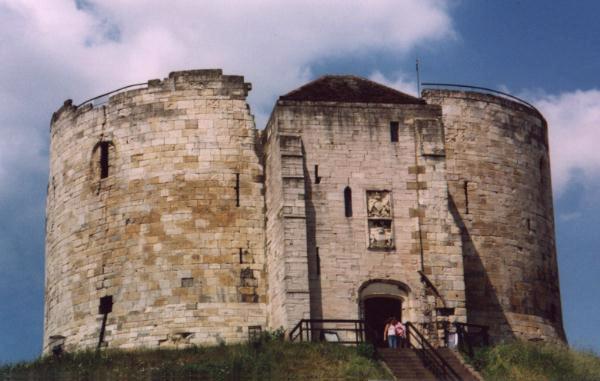
Clifford's Tower is the central stronghold of York Castle. The castle was first built by William The Conqueror to secure his hold on the north of England.
It featured earthwork defences, a timber tower on top of the mound or motte, and domestic buildings in the courtyard (now occupied by the law courts and museum).
Over a century after its construction, in 1190, the Jews of York took refuge in Clifford's Tower from a muderous mob. This tragic episode ended in their mass suicide, during which the tower was consumed by flames. There is now a plaque at the bottom of the steps that lead up to Clifford's Tower to commemorate the Jews that died at that time. It was put there in 1978 and reads:
"On the night of Friday 16th March 1190 some 150 Jews and Jewesses of York having sought protection in the Royal Castle on this site from a mob incited by Richard Malebisse and others chose to die at each others hands rather than renounce their faith"
This is followed by a line of Hebrew and under that it says ISIAH XLII 12.
It was rebuilt in stone by Henry II between 1245 and 1272, and has since survived floods, fire and partial destruction. Little now remains, however, of the curtain walls, towers and gates of the courtyard or outer bailey.
CLIFFORD'S TOWER, OR KEEP
In the Norman period the large earth mound supported a wooden look-out tower. This was later replaced by the four lobed royal keep you can see today known as Clifford's Tower. The keep comprised two floors of private rooms and a chapel.
THE EYE OF YORK
In medieval times this was the centre of the castle courtyard or bailey. Later, parliamentary elections were held here and the successful candidates names declared.
THE FEMALE PRISON (1780)
Designed by the York architect John Carr, the building today houses park of York Castle Museum.
THE DEBTORS PRISON (1705)
Designed by William Wakefield, the prison originally housed both debtors and felons; the yard at the back was used for executions after 1868.
SOUTH GATE
This twin towered gateway gave access to the rivers Ouse and Foss, the King's Mill, St George's Chapel and the Fishergate suburb.
THE CASTLE WALLS
Two corner towers of the curtain wall survive together with the foundation of the main south gate.
THE ASSIZE COURTS (1773-1777)
These finely decorated court rooms designed by John Carr were used by the High Sheriff, justices and judges.